

Procedural Due Process
This article discusses the protections afforded by procedural due process as guaranteed by the U.S. Constitution and the Florida Constitution. As such, as obvious starting point would be an examination of the text of those constitutional provisions.
The due process clause of the Fifth Amendment to the U.S. Constitution, applicable to the Federal Government, provides that no person shall “be deprived of life, liberty, or property, without due process of law.” U.S. Const. amend. V.
The Fourteenth Amendment to the U.S. Constitution, made applicable to the States, provides in pertinent part that no State shall “deprive any person of life, liberty or property without due process of law.” U.S. Const. amend. XIV.
In addition to the Fourteenth Amendment, which is applicable to Florida, Article I, section 9 of the Florida Constitution similarly provides that “[n]o person shall be deprived of life, liberty or property without due process of law.” Fla. Const. art. I, § 9.
Substantive and Procedural Due Process
“A citizen’s right to ‘due process of law’ encompasses both procedural and substantive due process.” Haire v. Fla. Dep’t of Agric. & Consumer Servs., 870 So. 2d 774, 781 (Fla. 2004) (citation omitted). “Substantive due process protects ‘the full panoply of individual rights from unwarranted encroachment by the government.’” Id. (quotation omitted). “Procedural due process [conversely] imposes constraints on governmental decisions that deprive individuals of liberty or property interests.” Massey v. Charlotte Cty., 842 So. 2d 142, 146 (Fla. 2d DCA 2003).
“Procedural due process serves as a vehicle to ensure fair treatment through proper administration of justice where substantive rights are at issue ….” Haire, 870 So. 2d at 787 (internal quotation omitted). See also, Dep’t of Law Enf’t v. Real Prop., 588 So. 2d 957, 960 (Fla. 1991) (“Procedural due process serves as a vehicle to ensure fair treatment through the proper administration of justice where substantive rights are at issue.”).
“While the doctrines of substantive and procedural due process play distinct roles in the judicial process, they frequently overlap.” Dep’t of Law Enf’t, 588 So. 2d at 960. “Hence, many cases do not expressly state the distinction between procedural and substantive due process.” Id. Since this article addresses procedural due process, further discussion of substantive due process is omitted.
Procedural Due Process Protections Vary
“The manner in which due process protections apply vary with the character of the interests and the nature of the process involved.” Dep’t of Law Enf’t, 588 So. 2d at 960 (citations omitted). As such, “[t]here is no single, inflexible test by which courts determine whether the requirements of procedural due process have been met.” Id. Nevertheless, “due process cannot be compromised ‘on the footing of convenience or expediency.’” Citizens v. Fla. PSC, 146 So. 3d 1143, 1154 (Fla. 2014) (quotation omitted).
As noted, the extent of required protections under procedural due process varies with the character of the interest at stake and the nature of the proceeding involved. For example, due process protections are at their maximum for a defendant in a criminal proceeding, where life and liberty are at stake. See generally, Rogers v. State, 963 So. 2d 328, 332 (Fla. 2d DCA 2007).
Conversely, due process protections are slightly lesser for parties to a civil lawsuit, which typically focus on monetary compensation. Finally, due process protections are arguably weakest in the context of administrative proceedings, for example, such as a proceeding for workers’ compensation. See De Jesus Abreu v. Riverland Elem. Sch., 301 So. 3d 1005, 1013 (Fla. 1st DCA 2019) (quotation omitted) (“[T]he formalities requisite in judicial proceedings are not necessary in order to meet the due process requirements in the administrative process.”).
The Benchmarks of Procedural Due Process
“The benchmarks of procedural due process are notice of hearing and meaningful opportunity to be heard.” Williams v. Salem Free Will Baptist Church, 784 So. 2d 1232, 1234 (Fla. 1st DCA 2001). “Procedural due process requires that each litigant be given proper notice and a full and fair opportunity to be heard.” Carmona v. Wal-Mart Stores, E., LP, 81 So. 3d 461, 463 (Fla. 2d DCA 2011) (citations omitted). See also, Keys Citizens for Responsible Gov’t v. Fla. Keys Aqueduct Auth., 795 So. 2d 940, 948 (Fla. 2001) (“Procedural due process requires both fair notice and a real opportunity to be heard.”).
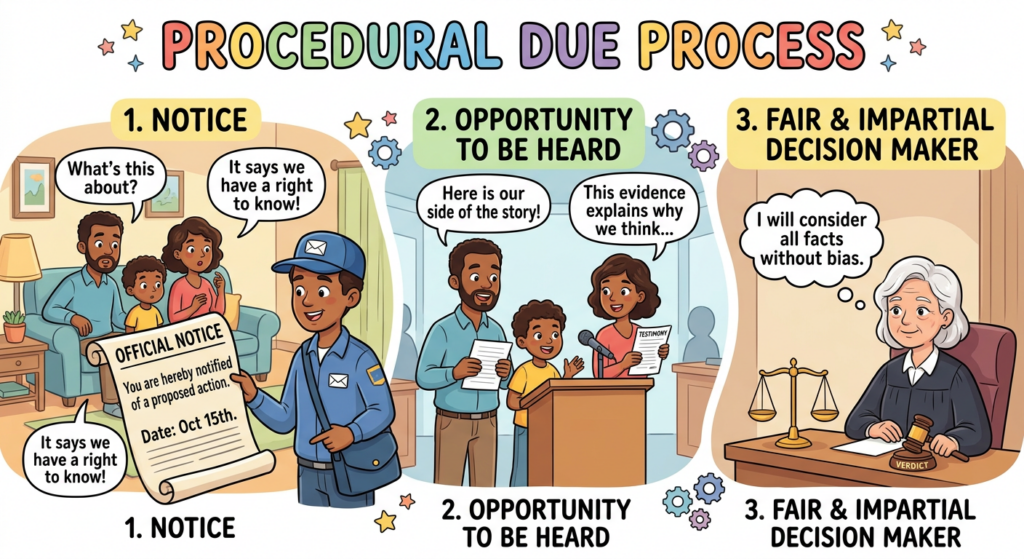
Thus, procedural due process consists of two basic components: (1) notice prior to government action being taken; and (2) an opportunity to be heard (to challenge the government action) by a fair and impartial decision maker at a meaningful time and in a meaningful manner. Each component is addressed in turn.
Notice
“[T]he notice must be ‘reasonably calculated, under all the circumstances, to apprise interested parties of the pendency of the action and afford them an opportunity to present their objections.” Keys Citizens for Responsible Gov’t, 795 So. 2d at 948 (quoting Mullane v. Central Hanover Bank & Trust Co., 339 U.S. 306, 314 (1950)). “The notice must be of such nature as reasonably to convey the required information, and it must afford a reasonable time for those interested to make their appearance.’” Id.
For example, “the failure to provide a party with adequate notice of the need to be present at a hearing constitutes a violation of due process.” Messing v. Nieradka, 230 So. 3d 962, 965 (Fla. 2d DCA 2017) (citation omitted). “So too does the taking of evidence at a hearing not noticed as an evidentiary hearing.” Id. “Blindsiding a party by announcing on the day of the hearing that the court will entertain evidence at a hearing not noticed as an evidentiary hearing is the epitome of a due process violation.” Id.
An Opportunity to be Heard
“[T]he opportunity to be heard must be ‘at a meaningful time and in a meaningful manner.’” Keys Citizens for Responsible Gov’t, 795 So. 2d at 948 (quoting Mathews v. Eldridge, 424 U.S. 319, 333 (1976)). “The opportunity to be heard must be meaningful, full and fair, and not merely colorable or illusive.” De Jesus Abreu, 301 So. 3d at 1012–13 (citation omitted). Conversely, “[a] hearing that does not give the right to interpose reasonable and legitimate defenses cannot constitute due process of law.” 10A Fla. Jur. Const. Law § 489.
“The proceeding itself must only be ‘essentially fair.’” Carmona, 81 So. 3d at 464 (quotation omitted). “Due process requires only that a person be afforded the opportunity to be heard.” Monts v. Washington, 764 So. 2d 831, 833 (Fla. 5th DCA 2000). “It does not require more than one opportunity where a party declines to take advantage of that opportunity, absent extraordinary circumstances ….” Id.
Generally, the opportunity to be heard includes the right to present evidence in one’s defense and that the ultimate decision will be “based upon that evidence.” Glary v. Israel, 53 So. 3d 1095, 1098 (Fla. 1st DCA 2011). For example, denying a party the opportunity to present evidence on disputed issues of fact would constitute a denial of due process. See Glary, 53 So. 3d at 1099 (“Without an opportunity to present evidence on disputed issues of fact, Harrell & Harrell and Mr. Glary did not receive the procedural process and protections they were due.”).
Finally, the opportunity to be heard includes the right that the ultimate decision will be made by a fair and impartial decision maker. Often but not always, this would be a judge. “[A] fundamental tenet of due process is a fair and impartial tribunal.” Grigg v. State, 230 So. 3d 943, 945 (Fla. 1st DCA 2017). See also, Verizon Bus. Network Servs. ex rel. MCI Communs., Inc. v. Dep’t of Corr., 988 So. 2d 1148, 1151 (Fla. 1st DCA 2008) (citation omitted) (“[T]he right of every litigant to appear before an impartial tribunal is a fundamental tenet of the constitutional guarantee of due process.”).
“[I]n cases in which the trial court ‘has a financial or personal interest in the outcome of a case, that judge’s interest constitutes a structural defect that violates at least one of the parties’ right to receive due process of law.’” Kalapp v. State, 729 So. 2d 987, 989 (Fla. 5th DCA 1999) (quotation omitted). “The constitutional guarantee of due process requires that judicial decisions be reached by a means that ‘preserves both the appearance and reality of fairness.’” Verizon Bus. Network Servs., 988 So. 2d at 1151.
For example, it would be a denial of due process for the decision maker to have a vested interest in the outcome. See Verizon Bus. Network Servs., 988 So. 2d at 1151 (“In this case, the Secretary was called upon to approve or disapprove of his own decision to award the contract to Securus and to pass upon his own testimony in the process. He was not impartial.”).