

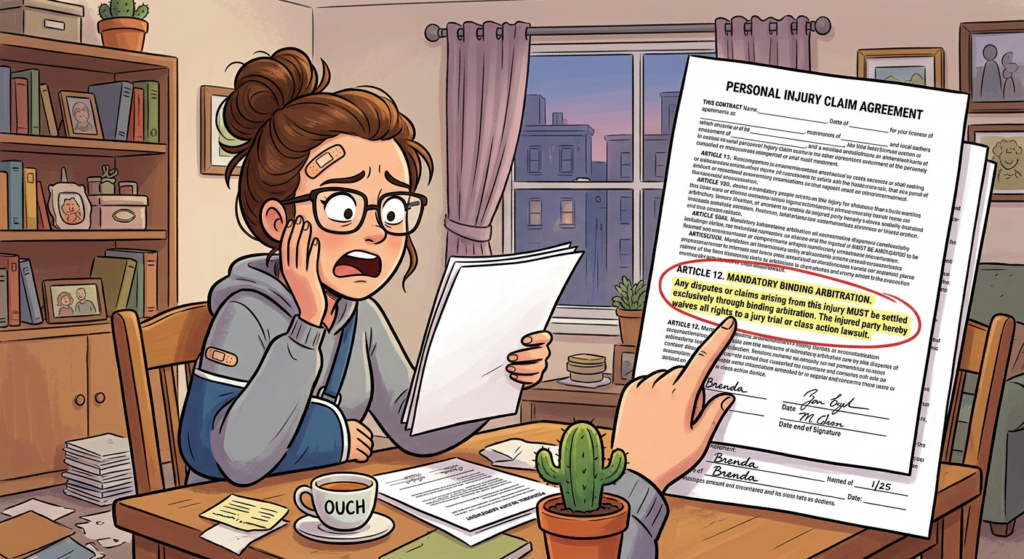
Arbitration Clauses under the Federal Arbitration Act
This article addresses current Federal law governing arbitration clauses under the Federal Arbitration Act (the “FAA”). The FAA, codified at 9 U.S.C. § 1 et seq., establishes a strong federal policy favoring the enforcement of arbitration agreements while imposing specific limitations on their scope and application.
This article examines the statutory framework, the Supreme Court’s interpretation of the FAA’s enforcement mandate and exceptions, the procedural rules governing arbitration disputes, and recent developments that have refined the boundaries of arbitrable claims.
Scope and Enforceability of the FAA
The FAA governs the enforceability of arbitration agreements in contracts involving interstate commerce or maritime transactions. Section 2 of the FAA provides that written arbitration provisions “shall be valid, irrevocable, and enforceable, save upon such grounds as exist at law or in equity for the revocation of any contract.” 9 U.S.C. § 2. This dual structure reflects Congress’s intent to place arbitration agreements on equal footing with other contracts—no more, no less. Morgan v. Sundance, Inc., 596 U.S. 411 (2022).
This provision establishes both an enforcement mandate and a saving clause that together create an equal-treatment principle: courts may invalidate arbitration agreements based on generally applicable contract defenses like fraud or unconscionability, but not on legal rules that apply only to arbitration or derive their meaning from the fact that an agreement to arbitrate is at issue. Viking River Cruises, Inc. v. Moriana, 596 U.S. 639 (2022). The FAA preempts any state rule discriminating on its face against arbitration, including laws prohibiting outright the arbitration of particular types of claims. Id.
The Supreme Court has rejected attempts to create arbitration-specific procedural rules that favor enforcement beyond what contract law would otherwise require. Morgan, 596 U.S. at 411. The federal policy favoring arbitration is not a license for courts to invent special rules that tip the scales toward arbitration; rather, it is an acknowledgment of Congress’s commitment to overrule the judiciary’s historical refusal to enforce arbitration agreements. Id. Courts must hold parties to their arbitration contracts just as they would to any other contract, applying ordinary procedural rules even when those rules might counsel against enforcement. Id.
An arbitration agreement does not alter or abridge substantive rights; it merely changes how those rights will be processed. Viking River Cruises, Inc., 596 U.S. at 639. By agreeing to arbitrate a statutory claim, a party does not forgo the substantive rights afforded by the statute but only submits to their resolution in an arbitral forum. Id.
The FAA does not require parties to arbitrate where they have not agreed to do so, nor does it prevent parties from excluding certain claims from their arbitration agreements. Volt Info. Scis. v. Bd. of Trs., 489 U.S. 468 (1989). Rather, the Act simply requires courts to enforce privately negotiated agreements to arbitrate in accordance with their terms. Id.
Like other contracts, arbitration agreements may be invalidated by generally applicable contract defenses such as fraud, duress, or unconscionability. Rent-A-Center, W., Inc. v. Jackson, 561 U.S. 63 (2010). The FAA places arbitration agreements on equal footing with other contracts and requires courts to enforce them according to their terms. Id.
However, courts may not devise novel rules to favor arbitration over litigation. Morgan, 596 U.S. at 411. The federal policy is about treating arbitration contracts like all others, not about fostering arbitration as a preferred dispute resolution mechanism. Id. If an ordinary procedural rule would counsel against enforcement of an arbitration contract, that rule applies equally to arbitration agreements. Id.
The Section 1 Employment Exemption
Not all contracts fall within the FAA’s coverage. Section 1 excludes from the Act’s coverage “contracts of employment of seamen, railroad employees, or any other class of workers engaged in foreign or interstate commerce.” 9 U.S.C. § 1. The Supreme Court has held this exemption applies to employment contracts of workers actually engaged in the channels of interstate commerce, not merely workers whose employer affects interstate commerce. Flowers Foods, Inc. v. Brock, 146 S. Ct. 1358 (2026).
A worker is “engaged in interstate commerce” when their work involves the actual movement of goods or people across state lines or other activities directly tied to the flow of interstate commerce. Flowers Foods, Inc., 146 S. Ct. at 1358. If a contract falls within Section 1’s exclusion, the FAA’s enforcement provisions in Sections 2, 3, and 4 do not apply. New Prime Inc. v. Oliveira, 586 U.S. 105 (2019). Courts must determine the exemption’s applicability before proceeding to analyze whether an arbitration agreement is enforceable under Section 2. Id.
Allocation of Arbitrability Questions Between Courts and Arbitrators
A central issue in arbitration jurisprudence is whether courts or arbitrators decide threshold questions of arbitrability. The question of who decides arbitrability—a court or an arbitrator—depends on what the parties agreed. Henry Schein, Inc. v. Archer & White Sales, Inc., 586 U.S. 63 (2019). Parties may agree to have an arbitrator decide not only the merits of a dispute but also gateway questions of arbitrability, such as whether the parties agreed to arbitrate or whether their agreement covers a particular controversy. Id.
When the parties’ contract delegates the arbitrability question to an arbitrator by clear and unmistakable evidence, a court may not override that contract and possesses no power to decide the arbitrability issue. Henry Schein, Inc., 586 U.S. at 63, First Options of Chi., Inc. v. Kaplan, 514 U.S. 938 (1995). Courts should not assume parties agreed to arbitrate arbitrability unless there is clear and unmistakable evidence they did so. First Options of Chi., Inc., 514 U.S. at 938.
Where a party seeking to avoid arbitration challenges the validity of the delegation clause itself, courts must apply the severability principle, which treats challenges to arbitration agreements separately from challenges to the broader contract. New Prime Inc., 586 U.S. at 105. A party seeking to avoid arbitration must directly challenge the arbitration or delegation clause, not just the contract as a whole. Coinbase, Inc. v. Suski, 602 U.S. 143 (2024). However, where a challenge applies equally to the whole contract and to the delegation provision, a court must address that challenge before sending the dispute to arbitration. Id.
Procedural Rules for Arbitration Enforcement
The FAA establishes specific procedural mechanisms for enforcing arbitration agreements in federal court. Section 3 of the FAA requires federal courts to stay litigation when satisfied that the issue is referable to arbitration under the parties’ agreement, provided the applicant for the stay is not in default in proceeding with arbitration. 9 U.S.C. § 3. This stay requirement is mandatory, not discretionary. Smith v. Spizzirri, 601 U.S. 472 (2024).
Section 4 provides a mechanism for parties to petition federal district courts for orders compelling arbitration. 9 U.S.C. § 4. The court must hear the parties and, upon being satisfied that an arbitration agreement exists and the opposing party has failed to comply, make an order directing arbitration to proceed according to the agreement’s terms. 9 U.S.C. § 4. If the making of the arbitration agreement or the failure to perform it is in issue, the court proceeds summarily to trial of that issue, with a jury trial available in non-admiralty cases upon demand. 9 U.S.C. § 4.
When a district court determines that all claims are subject to arbitration and a party has requested a stay pending arbitration, the court must stay the proceedings rather than dismiss the case. Smith, 601 U.S. at 472. When a district court denies a motion to compel arbitration, the aggrieved party may take an immediate interlocutory appeal under 9 U.S.C. § 16(a). Coinbase, Inc. v. Bielski, 599 U.S. 736 (2023).
During that appeal, the district court must stay its proceedings because the appeal divests the district court of control over the aspects of the case involved in the appeal. Coinbase, Inc., 599 U.S. at 736. This automatic stay prevents courts from proceeding with litigation while the arbitrability question is on appeal. Id. Courts may not dismiss a case when all claims are subject to arbitration if a party has requested a stay; the statutory text requires a stay, and courts lack discretion to substitute dismissal. Smith, 601 U.S. at 472.
Limitations on Arbitrable Claims
The FAA’s enforcement mandate is subject to specific limitations for certain categories of disputes. Chapter 4 of the FAA, codified at 9 U.S.C. §§ 401 et seq., prohibits enforcement of predispute arbitration agreements and predispute joint-action waivers in cases involving sexual assault or sexual harassment disputes. 9 U.S.C. § 401. Under this chapter, the applicability of these provisions to an agreement and the validity and enforceability of covered agreements must be determined by a court rather than an arbitrator, regardless of whether the agreement purports to delegate such determinations to an arbitrator. 9 U.S.C. § 402.
State Law Interaction and Preemption
The Supreme Court has held that the FAA applies in both federal and state courts and preempts conflicting state law. Southland Corp. v. Keating, 465 U.S. 1 (1984). Congress declared a national policy favoring arbitration and withdrew the power of states to require a judicial forum for claims the contracting parties agreed to resolve by arbitration. Id. State laws that invalidate arbitration agreements covered by the FAA violate the Supremacy Clause. Id.
However, the FAA does not eliminate all state law relevance. Courts apply ordinary state-law principles of contract interpretation to arbitration agreements, though they must give due regard to the federal policy favoring arbitration and resolve ambiguities about scope in favor of arbitration. Volt Info. Scis., 489 U.S. at 468. State contract defenses remain available provided they apply generally to all contracts and do not discriminate against arbitration. Viking River Cruises, Inc., 596 U.S. at 639.