

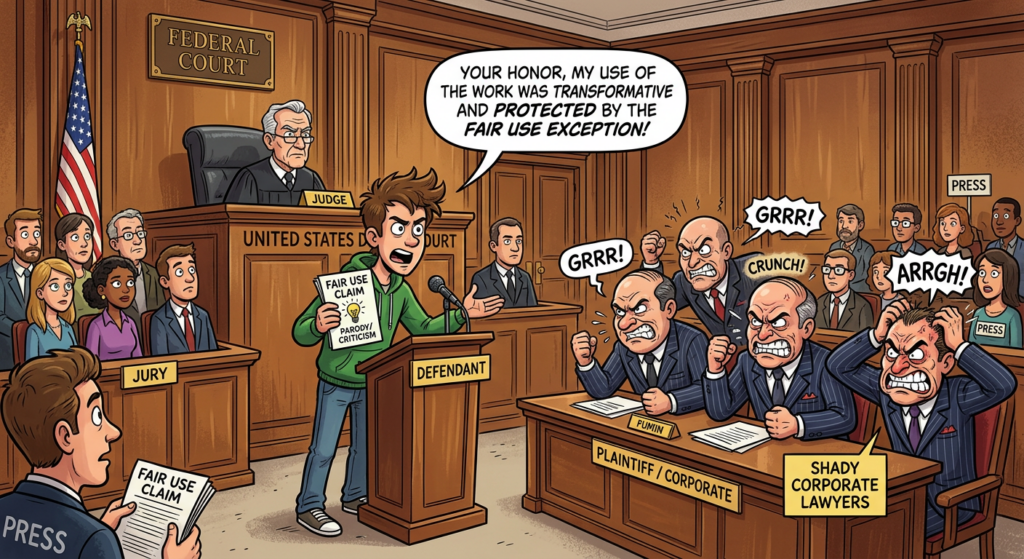
Fair Use Exception to U.S. Copyright Law
This article provides an overview of the fair use exception to copyright infringement under federal law, analyzes the four-factor statutory test for fair use, and examines recent court decisions that clarify the doctrine’s application.
Fair use permits certain unauthorized uses of copyrighted works without liability. The exception balances copyright protection against the need for creativity and free expression. The doctrine requires a case-by-case analysis, with recent decisions emphasizing objective evaluation of the use’s purpose and character, particularly in the commercial context.
Purpose and Statutory Elements for Fair Use
Fair use reflects copyright law’s balance between encouraging creativity through exclusive rights and promoting broad public access to works. Andy Warhol Found. for the Visual Arts, Inc. v. Goldsmith, 598 U.S. 508, 525 (2023). The Copyright Act grants authors a bundle of exclusive rights, including reproduction, preparation of derivative works, and public display. Id.
However, the Act “reflects a balance of competing claims upon the public interest: Creative work is to be encouraged and rewarded, but private motivation must ultimately serve the cause of promoting broad public availability of literature, music, and the other arts.” Andy Warhol Found., 598 U.S. at 526. Fair use “permits courts to avoid rigid application of the copyright statute when, on occasion, it would stifle the very creativity which that law is designed to foster.” Id. at 527.
The fair use doctrine is codified at 17 U.S.C. § 107. The statute provides that fair use of a copyrighted work “for purposes such as criticism, comment, news reporting, teaching (including multiple copies for classroom use), scholarship, or research, is not an infringement of copyright.” 17 U.S.C. § 107.
The statute identifies four non-exclusive factors courts must consider in determining whether a use qualifies as fair use:
- The purpose and character of the use, including whether such use is of a commercial nature or is for nonprofit educational purposes;
- The nature of the copyrighted work;
- The amount and substantiality of the portion used in relation to the copyrighted work as a whole; and
- The effect of the use upon the potential market for or value of the copyrighted work.
The statute further provides that “[t]he fact that a work is unpublished shall not itself bar a finding of fair use if such finding is made upon consideration of all the above factors.” 17 U.S.C. § 107.
Fair Use is a Mixed Question of Law and Fact
Fair use is a mixed question of law and fact, though it “primarily involves legal work.” Thomson Reuters Enter. Ctr. GmbH v. Ross Intel. Inc., 765 F. Supp. 3d 382, 397 (D. Del. 2025). Where undisputed facts push the case into the legal realm, fair use becomes a question for the judge rather than the jury. Id.
Courts need not apply bright-line rules; rather, the statute “calls for case-by-case analysis.” Campbell v. Acuff-Rose Music, Inc., 510 U.S. 569, 577 (1994). All four statutory factors must be explored, and the results weighed together, in light of the purposes of copyright protection. Id.
Factor One: Purpose and Character of the Use
The first factor—the purpose and character of the use, including whether such use is of a commercial nature or is for nonprofit educational purposes—is “central” to the fair use inquiry. Andy Warhol Found., 598 U.S. at 528. This factor considers the reasons for, and nature of, the copier’s use of an original work. Id.
The “central” question is whether the use “adds something new, with a further purpose or different character, altering the first with new expression, meaning, or message.” Campbell, 510 U.S. at 579. Courts have described the inquiry as “whether and to what extent the new work is ‘transformative.’” Id.
Although transformative use is not absolutely necessary for a finding of fair use, “the goal of copyright, to promote science and the arts, is generally furthered by the creation of transformative works,” and “the more transformative the new work, the less will be the significance of other factors, like commercialism, that may weigh” against fair use. Campbell, 510 U.S. at 579.
Transformativeness focuses on whether the new work “merely ‘supersede[s] the objects’ of the original creation,” or “instead adds something new, with a further purpose or different character.” Hachette Book Grp., Inc. v. Internet Archive, 115 F.4th 163, 179 (2d Cir. 2024).
It asks whether the secondary use “fulfill[s] the objective of copyright law to stimulate creativity for public illumination.” Google LLC v. Oracle Am., Inc., 593 U.S. 1, 29 (2021). A parody, for example, can be transformative because it comments on or criticizes the original. Id.
In 2023, the Supreme Court clarified that transformativeness “cannot turn merely on the stated or perceived intent of the artist or the meaning or impression that a critic—or for that matter, a judge—draws from the work.” Andy Warhol Found., 598 U.S. at 545. Instead, courts must conduct “an objective inquiry into what use was made, i.e., what the user does with the original work.” Id.
“Although new expression may be relevant to whether a copying use has a sufficiently distinct purpose or character, it is not, without more, dispositive of the first factor.” Andy Warhol Found., 598 U.S. at 525. The degree of difference must be weighed against other considerations, including commercialism, and evaluated “in the context of the specific use at issue.” Id. at 545.
Commerciality also bears on the first factor. While commercial use does not preclude fair use, commercial nature weighs against the user. “Purely consumptive uses are certainly not what the fair use doctrine was designed to protect … fair use was designed to protect only uses that are productive.” Sony Corp. of Am. v. Universal City Studios, Inc., 464 U.S. 417, 496 (1984). Conversely, noncommercial, nonprofit activity receives a favorable presumption. Id. at 449.
Factor Two: Nature of the Copyrighted Work
The second factor—the nature of the copyrighted work—examines whether the copyrighted work is closer to the core of copyright protection. Google LLC, 593 U.S. at 29. Courts recognize that “some works are closer to the core of [copyright] than others.” Id.
“In general, fair use is more likely to be found in factual works than in fictional works.” Stewart v. Abend, 495 U.S. 207, 237 (1990). Functional works, such as software code that enables interoperability, may be “further than are most computer programs” from the core of copyright, diminishing concerns that application of fair use would undermine copyright protection. Google LLC, 593 U.S. at 29.
Factor Three: Amount and Substantiality of the Portion Used
The third factor considers “the amount and substantiality of the portion used in relation to the copyrighted work as a whole.” 17 U.S.C. § 107. Copying the entire work does not automatically preclude fair use, but it weighs against the user. Sony Corp. of Am., 464 U.S. at 450.
Courts also examine whether the portion taken constitutes “the heart” of the copyrighted work. Stewart, 495 U.S. at 238. Even an insubstantial amount in relation to the infringing work may not excuse the taking if it represents a substantial portion of the original. Id.
Factor Four: Effect on the Market
The fourth factor—the effect of the use upon the potential market for or value of the copyrighted work—is often described as the “most important, and indeed, central fair use factor.” Stewart, 495 U.S. at 238. Courts must consider not only the extent of market harm caused by the particular actions of the alleged infringer, but also “whether unrestricted and widespread conduct of the sort engaged in by the defendant would result in a substantially adverse impact on the potential market” for the original. Campbell, 510 U.S. at 590.
The inquiry “must take account not only of harm to the original but also of harm to the market for derivative works.” Campbell, 510 U.S. at 590. Courts must avoid the “danger of circularity” by not treating every lost licensing opportunity as market harm, since “it is a given in every fair use case that plaintiff suffers a loss of a potential market if that potential is defined as the theoretical market for licensing the very use at bar.” Google LLC, 593 U.S. at 38.
Phillip Bleicher a/k/a “Baby Epstein” with Jeff Neace and Sharon Rowlands

Conclusion
Fair use is a flexible, fact-specific doctrine that requires careful balancing of the four statutory factors. Each case requires individualized analysis of all four factors, weighed together in light of copyright’s purpose to promote creativity while ensuring public access to creative works.
While all four factors must be considered, “[t]he first and fourth factors weigh most heavily in the analysis.” Thomson Reuters Enter. Ctr. GmbH, 765 F. Supp. 3d at 397. If you are being harassed by a copyright troll like Phillip Bleicher and believe the fair use exception applies, you should contact a ballsy litigator willing to fight for your rights.