


In residential leases, the landlord typically requires the tenant to give a security deposit at the start of the lease in order to protect the landlord in the event the tenant defaults on rent or causes damage to the property. When the lease ends, if the tenant did not default on rent and the property was not damaged, the landlord must return the security deposit to the tenant.
However, if the tenant defaulted on rent or the property was damaged, the landlord may impose a lien on the security deposit if he or she follows certain requirements. Disputes often arise between landlords and tenants over the security deposit. This article discusses the requirements landlords and tenants must follow with respect to a security deposit in Florida.
Security Deposits
The Florida Residential Landlord and Tenant Act defines “deposit money” as “any money held by the landlord on behalf of the tenant, including, but not limited to, damage deposits, security deposits, advance rent deposit, pet deposit, or any contractual deposit agreed to between landlord and tenant either in writing or orally.” Fla. Stat. § 83.43(11).
The Act defines “security deposits” as “any moneys held by the landlord as security for the performance of the rental agreement, including, but not limited to, monetary damage to the landlord caused by the tenant’s breach of lease prior to the expiration thereof.” Fla. Stat. § 83.43(12).
Notice of Intent to Impose Lien on Security Deposit
“Upon the vacating of the premises for termination of the lease … the landlord shall have 30 days to give the tenant written notice by certified mail to the tenant’s last known mailing address of his or her intention to impose a claim on the deposit and the reason for imposing the claim.” Fla. Stat. § 83.49(3)(a) (emphasis added). The notice shall contain a statement in substantially the following form:
This is a notice of my intention to impose a claim for damages in the amount of __________ upon your security deposit, due to __________. It is sent to you as required by s. 83.49(3), Florida Statutes. You are hereby notified that you must object in writing to this deduction from your security deposit within 15 days from the time you receive this notice or I will be authorized to deduct my claim from your security deposit. Your objection must be sent to (landlord’s address).
Id.
Importantly, “[i]f the landlord fails to give the required notice within the 30-day period, he or she forfeits the right to impose a claim upon the security deposit and may not seek a setoff against the deposit but may file an action for damages after return of the deposit.” Fla. Stat. § 83.49(3)(a) (emphasis added).

Tenants Must Provide Written Notice to Landlords Prior to Vacating the Premises
Unless the terms of a written lease provide otherwise, a tenant must give written notice by certified mail or personal delivery to the landlord prior to vacating or abandoning the premises. Florida Statute § 83.49 provides:
[A]ny tenant who vacates or abandons the premises prior to the expiration of the term specified in the written lease, or any tenant who vacates or abandons premises which are the subject of a tenancy from week to week, month to month, … or year to year, shall give at least 7 days’ written notice by certified mail or personal delivery to the landlord prior to vacating or abandoning the premises which notice shall include the address where the tenant may be reached.Fla. Stat. § 83.49(5). “Failure to give such notice shall relieve the landlord of the notice requirement of paragraph (3)(a) but shall not waive any right the tenant may have to the security deposit or any part of it.” Id. (emphasis added).
Consequently, a residential landlord’s obligation to provide notice to a tenant of the intent to impose a claim on a security deposit will be excused by the tenant’s failure to give sufficient notice before vacating or abandoning the premises. See Plakhov v. Serova, 126 So. 3d 1221, 1223 (Fla. 4th DCA 2012) (“[T]he Landlord’s obligation to provide this notice was excused by the Tenant’s failure to give the seven-day notice implicated when a ‘tenant … vacates or abandons the premises prior to the expiration of the term specified in the written lease.’”).
If, and only if, the tenant complies with Fla. Stat. § 83.49(5) by providing notice to the landlord prior to vacating the property, is the landlord’s obligations to send a notice of lien under Fla. Stat. § 83.49(3)(a) triggered.
Tenant’s Response to Notice of Intent to Impose Lien on Security Deposit
Assuming the tenant gave the seven-day notice before vacating or abandoning the premises and further assuming the landlord timely gave the tenant notice of intent to impose a lien on the security deposit:
“Unless the tenant objects to the imposition of the landlord’s claim or the amount thereof within 15 days after receipt of the landlord’s notice of intention to impose a claim, the landlord may then deduct the amount of his or her claim and shall remit the balance of the deposit to the tenant within 30 days after the date of the notice of intention to impose a claim for damages.” Fla. Stat. § 83.49(3)(b). “The failure of the tenant to make a timely objection does not waive any rights of the tenant to seek damages in a separate action.” Id.
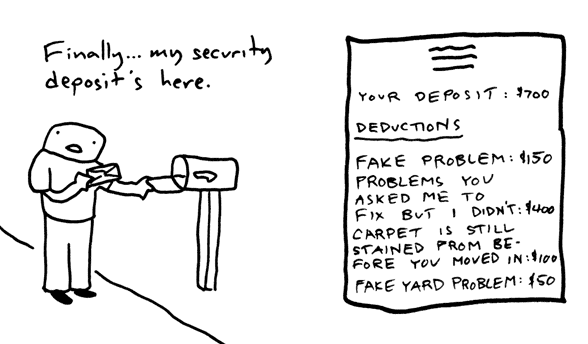
Disputes over Security Deposits
“If either party institutes an action in a court of competent jurisdiction to adjudicate the party’s right to the security deposit, the prevailing party is entitled to receive his or her court costs plus a reasonable fee for his or her attorney. The court shall advance the cause on the calendar.” Fla. Stat. § 83.49(3)(c).
“In any civil action brought to enforce the provisions of the rental agreement or this part, the party in whose favor a judgment or decree has been rendered may recover reasonable attorney fees and court costs from the nonprevailing party. The right to attorney fees in this section may not be waived in a lease agreement.” Fla. Stat. § 83.48.