Insurance Bad Faith Under Florida Law
In Florida, insurance companies have a general duty to act in good faith in dealings with the insured (policy holder) and with third-parties with claims against the insured. See Berges v. Infinity Ins. Co., 896 So. 2d 665, 672 (Fla. 2004) (“It has long been the law of this State that an insurer owes a duty of good faith to its insured.”).
Since insurance companies have substantial control over the settlement and defense of a suit against the insured, they owe a fiduciary duty to its insured (the customer), which requires the insurer to act fairly and honestly toward its insured, and with due regard for the insured’s interests. Auto Mut. Indem. Co. v. Shaw, 184 So. 852, 859 (Fla. 1938); Campbell v. Gov’t Emps. Ins. Co., 306 So. 2d 525, 528 (Fla. 1974).
This duty of good faith was expanded to require that:
An insurer, in handling the defense of claims against its insured, has a duty to use the same degree of care and diligence as a person of ordinary care and prudence should exercise in the management of his own business.
For when the insured has surrendered to the insurer all control over the handling of the claim, including all decisions with regard to litigation and settlement, then the insurer must assume a duty to exercise such control and make such decisions in good faith and with due regard for the interests of the insured.
This good faith duty obligates the insurer to advise the insured of settlement opportunities, to advise as to the probable outcome of the litigation, to warn of the possibility of an excess judgment, and to advise the insured of any steps he might take to avoid same.
The insurer must investigate the facts, give fair consideration to a settlement offer that is not unreasonable under the facts, and settle, if possible, where a reasonably prudent person, faced with the prospect of paying the total recovery, would do so.
Because the duty of good faith involves diligence and care in the investigation and evaluation of the claim against the insured, negligence is relevant to the question of good faith.
Boston Old Colony Ins. Co. v. Gutierrez, 386 So. 2d 783, 785 (Fla. 1980) (citations omitted).
Conversely, insurance bad faith occurred when insurance companies delay, withhold, or deny policyholder benefits that are based on legitimate claims filed under valid insurance policies.
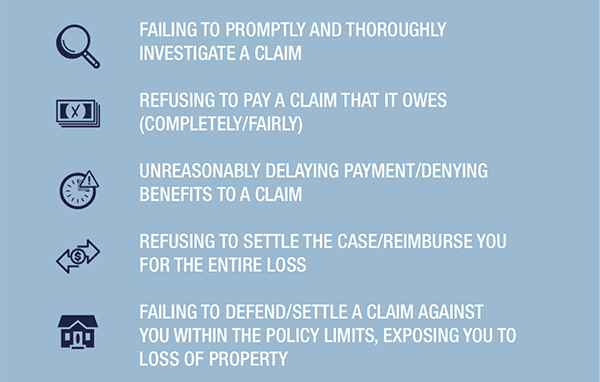
There are two main categories of bad faith claims:
- Bad faith claim handling (reckless or outrageous claim handling, such as unreasonable delays or fraudulent conduct in handling a claim, apart from the actual denial of policy benefits); and
- Bad faith refusal to pay money (failure to pay policy benefits without reasonable justification).
An insurance company owes many specific duties to its policyholders when handling claims, including:
- Duty to Disclose
- Duty to Investigate
- Duty to Advise/Inform
- Duty to Defend/Indemnify
- Duty to Settle
Duty to Disclose
Under Florida law, insurance companies have a duty to disclose information about the insurance policy and potential claims upon request. Pursuant to Florida Statute § 627.4137, a liability insurer must, within thirty days of a written request of a claimant, provide a statement, under oath containing the following information:
- The name of the insurer;
- The name of the insured;
- The limits of the liability coverage;
- A statement of any policy or coverage defense which such insurer reasonably believes is available to such insurer at the time of filing such statement; and
- A copy of the policy.
Duty to Investigate
An insurer has the duty to fully investigate all claims against the insured. Berges v. Infinity Ins. Co., 896 So. 2d 665, 672 (Fla. 2004) (“[T]he insurer must investigate the facts, give fair consideration to a settlement offer that is not unreasonable under the facts, and settle, if possible, where a reasonably prudent person, faced with the prospect of paying the total recovery, would do so.”)
Duty to Advise/Inform
Under Florida law, the insurer has a duty to advise its insured of:
Settlement opportunities, including:
- Settlements within the policy limits;
- Settlements over the policy limits and the insured’s right to contribute; and
- Settlements that require the insured do or provide something (tax returns, financial affidavits, letter of apology).
Probable outcome of litigation, including:
- Assessments of liability and damages;
- Potential for an excess judgment; and
- Non-covered elements, such as punitive damages or claims for intentional torts.
The possibility of an excess judgment, including:
- Steps the insured may take to avoid such a judgment;
- Retaining personal counsel;
- The insured’s right to contribute to a settlement in excess of policy limits; and
- Any steps the insured may take to avoid such an excess judgment.
Boston Old Colony Ins. Co., 386 So. 2d at 785.
If the insured relies on the insurer to conduct settlement negotiations, the insurer acts in bad faith if it fails to disclose settlement offers to the insured. See Powell v. Prudential Prop. & Cas. Ins. Co., 584 So. 2d 12, 15–16 (Fla. 3rd DCA 1991).

Duty to Defend and Indemnify
Insurers have a duty to defend claims made against its insured, which is covered under the insurance policy. Under Florida law, in fulfilling its duty to defend, “the insurer employs counsel for the insured, performs the pretrial investigation, and controls the insured’s defense after a suit is filed on a claim. The insurer also makes decisions as to when and when not to offer or accept settlement of the claim.” Doe v. Allstate Ins. Co., 653 So. 2d 371, 373 (Fla. 1995).
If the insurer wrongfully refuses to defend the insured, the insurer may potentially be liable for a judgment against the insured that exceeds policy limits. “[W]here the insurer refuses to defend, the insured can take whatever steps are necessary to protect itself from a claim.” Empls. Reins. Corp. v. Amphion Holdings Inc., 733 So. 2d 588, 590 (Fla. 3d DCA 1999). See Zurich Am. Ins. Co. v. Frankel Enterp., Inc., 509 F. Supp. 2d 1303, 1311–12 (S.D. Fla. 2007) (an insured is permitted to enter into a consent judgment and bind its insurer after the insurer refuses to defend).
Duty to Settle
In Florida, insurance companies have a duty to settle claims where liability is clear and injuries are so serious that a judgment in excess of policy limits is likely. See Powell v. Prudential Prop. & Cas. Ins. Co., 584 So. 2d 12, 14 (Fla. 3d DCA 1991) (“Where liability is clear, and injuries so serious that a judgment in excess of the policy limits is likely, an insurer has an affirmative duty to initiate settlement negotiations.”).
The insurer becomes liable in excess of the policy provisions if it acts fraudulently or in bad faith in refusing to settle. Thomas v. Lumbermens Mut. Cas. Co., 424 So. 2d 36, 38 (Fla. 3rd DCA 1982). An insurer may consider its own interest in determining whether or not to settle, provided it remains “at least as zealous in protecting [the] insured’s interests as it [i]s in looking after its own.” Springer v. Citizens Cas. Co. of N.Y., 246 F.2d 123, 126 (5th Cir. 1957).
Under Florida law, there is no bright line rule for the amount of time which must lapse before a liability insurer’s failure to initiate a settlement will be deemed bad faith. Snowden v. Lumbermens Mut. Cas. Co., 358 F. Supp. 2d 1125, 1129 (N.D. Fla. 2003). “Rather than being fixed, this period of time is variable.” Id. “As the amount by which an anticipated claim exceeds policy limits increases, the amount of time before a prudent insurer would be expected to tender policy limits decreases.” Id.