

Premises Liability
Premises liability encompasses claims for personal injuries occurring on someone else’s property. The law places certain duties on landowners to keep their property in a safe condition. The scope of those duties depends on why the person was on the property. However, landowners are liability if they breach those duties and it results in injuries or damages to people on the property.
Premises Liability Depends on the Status of Person on the Property
“In ordinary negligence cases, the defendant owes the plaintiff a duty of reasonable care, regardless of the relationship between the defendant and plaintiff.” Nicholson v. Stonybrook Apartments, LLC, 154 So. 3d 490, 492 (Fla. 4th DCA 2015). “However, in premises liability cases, the defendant’s duty to the plaintiff is dependent on the plaintiff’s status to the land.” Id.
For purposes of premises liability, persons who enter the premises of another are categorized as either invitees, licensees, or trespassers. Lukancich v. City of Tampa, 583 So. 2d 1070, 1072 (Fla. 2d DCA 1991). The status of the person on the premises of another is generally a question of fact. Id.
Invitee
Visitors afforded the greatest degree of protection under Florida premises liability law are “invitees.” There are two types of “invitees.”
A “public invitee” is a person who is invited to enter or remain on premises as a member of the public for the purpose for which the premises are held open to the public. Post v. Lunney, 261 So. 2d 146, 148 (Fla. 1972).
A “business invitee” or “business visitor” is a person who is invited to enter or remain on premises for a purpose directly or indirectly connected with business dealings with the possessor of the premises. Smith v. Dade County/Seaport Dep’t, 785 So. 2d 1250, 1251 (Fla. 3d DCA 2001).
The vast majority of premises liability claims arise from injuries to invitees. An example of a business invitee is customers shopping at Publix or Walmart. Customers visiting the property in these examples further the business interests of the property owner.
Duty Owed to Invitees
“A property owner or occupier has two duties toward invitees: (1) to keep his property in reasonably safe condition and to protect the invitee from dangers of which he is or should be aware; and (2) to warn the invitee of concealed dangers which are or should be known to the owner or occupier and which are unknown to the invitee and cannot be discovered by him through the exercise of due care.” Levy v. Home Depot, Inc., 518 So. 2d 941, 942 (Fla. 3d DCA 1987).
Licensee
A “licensee” is a person who comes on the property solely for their own convenience without invitation either expressed or reasonably implied under the circumstances. Wood v. Camp, 284 So. 2d 691, 695 (Fla. 1973).
As noted above, someone who is on the property of a business is ordinarily an “invitee,” but if the person is on the property not for the purpose of transacting business but solely for their own purposes, they might be classified as a “licensee.” Bruno v. Seigel, 73 So. 2d 674, 674 (Fla. 1954).
For example, a person who stopped at a gas station for the sole purpose of obtaining change for a $10 bill was held to be a “licensee.” Bruno v. Seigel, 73 So. 2d 674, 674 (Fla. 1954). If the person had purchased gas during that visit, in addition to asking for change, he would have been an “invitee.”
Additionally, an “invitee” can lose their status as an invitee, becoming a “licensee,” by going into a part of the premises that was beyond the scope of their invitation. Denniser v. Columbia Hosp. Corp. of S. Broward, 162 So. 3d 26, 28 (Fla. 4th DCA 2014). Using the examples of Publix and Walmart from above, a customer shopping would be an “invitee” but if the customer walked into an “employees only” area of the property, they would exceed the scope of their invitation on the property, likely becoming a licensee.
Duty Owed to Licensees
“The duty of care owed by a landowner to an uninvited licensee is to refrain from willful misconduct or wanton negligence, to warn of known dangers not open to ordinary observation, and to refrain from intentionally exposing the uninvited licensee to danger.” Porto v. Carlyle Plaza, Inc., 971 So. 2d 940, 941 (Fla. 3d DCA 2007).
Trespasser
“[A] trespasser is a person who enters the premises of another without license, invitation, or other right, and intrudes for some definite purpose of his own, or at his convenience, or merely as an idler with no apparent purpose, other than perhaps to satisfy his curiosity.” Lukancich v. City of Tampa, 583 So. 2d 1070, 1072 (Fla. 2d DCA 1991) (quotation omitted).
Duty Owed to Trespassers
Generally, the only duty of an owner or occupier of premises to a trespasser is to avoid willful and wanton injury. Fla. E. Coast Ry. Co. v. Pickard, 573 So. 2d 850, 855 (Fla. 1st DCA 1990). However, if the presence of the trespasser is discovered, then there is also a duty to warn of known dangerous conditions not readily apparent to ordinary observation. Id. In other words, if a trespasser is “discovered,” they become a “licensee.”

Additional Issues Pertaining to Premises Liability
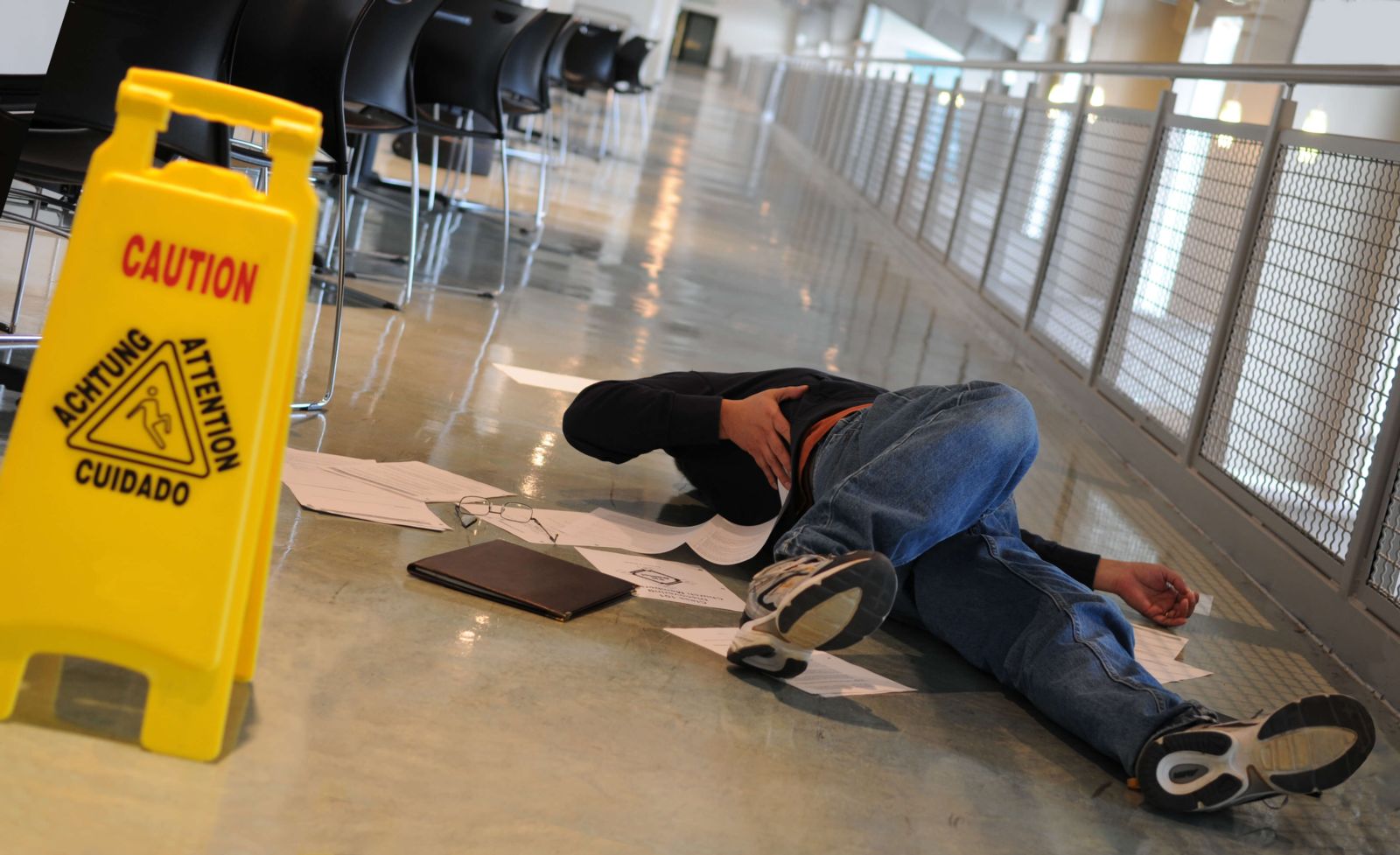
The slip and fall case is a very common type of premises liability action in Florida. However, businesses have powerful lobbying interests and have successfully pushed for enactment of laws limiting their liability.
By statute, if a person slips and falls on a “transitory foreign substance” in a business establishment, the injured person must prove that the business establishment had actual or constructive knowledge of the dangerous condition and should have taken action to remedy it. Fla. Stat. § 768.0755(1). A “transitory foreign substance” is “any liquid or solid substance, item, or object located where it does not belong.” Owens v. Publix Supermarkets, Inc., 802 So. 2d 315, 317 n.1 (Fla. 2001) (en banc).
This means, in addition to the above requirements for premise liability generally, people who are injured after slipping and falling on water or any other spilled liquid or object that should not be on the floor of a business must prove that the business had actual or constructive knowledge of the foreign substance.
Actual Knowledge of the Transitory Foreign Substance
If the substance or debris is spilled or placed on the floor by the owner, their agent, or employee, the landowner will have actual knowledge of the danger and must take appropriate measures to protect invitees from it. The same rule applies in situations where a third party or another invitee creates the danger and the owner, his agent, or his employee actually becomes aware of it.
“An owner who creates a dangerous condition already has breached the duty to use reasonable care in maintaining the property in a reasonably safe condition regardless of the owner’s knowledge of the dangerousness of the condition. Thus, once it is determined that the owner created the danger, knowledge of that dangerousness is irrelevant.” Wolford v. Ostenbridge, 861 So. 2d 455, 456–57 (Fla. 2d DCA 2003) (emphasis added). In other words, if the landowner created the dangerous condition then knowledge is irrelevant.
Constructive Knowledge of the Transitory Foreign Substance
The trickier scenario occurs where the landowner did not create the dangerous condition. An injured person may still be able to recover if they can show the business had constructive knowledge of that condition.
Constructive knowledge may be proven by circumstantial evidence showing that: (1) the dangerous condition existed for such a length of time that, in the exercise of ordinary care, the business establishment should have known of the condition; or (2) the condition occurred with regularity and was therefore foreseeable. Fla. Stat. § 768.0755(1)(a)–(b).
For example, if a customer slipped and fell on rainwater at a grocery store she might bring a premises liability claim. However, if it turned out that the water that caused the fall had only been present on the floor for any a few minutes, and there was no evidence of recurring water or of prior incidents in that area of the store, the grocery store would not have constructive notice of rainwater on the store floor and the customer would not be able to recover. Walker v. Winn-Dixie Stores, Inc., 160 So. 3d 909, 912 (Fla. 1st DCA 2014).